KOVEST

Kovest white paper

TRAK-led maintenance capability

How TRAK workflow management, drill service teams, low power edge AI, operations integration, operational technology and project planning support operational oversight, productivity and accountability.

Executive position

TRAK is the workflow application.

The operating direction is practical: make work visible, make evidence reviewable, make people accountable, and connect field activity to the systems that make decisions.

TRAK is the workflow management application: built for work orders, inspections, digital documentation, pre-task risk activity, field evidence, time capture and integration with existing management systems.

Company capability map

Five capability areas, one operating direction.

TRAKField work becomes structured work orders, scan-tag context, inspection evidence, completion packs, approved package revisions and reviewable records.
Field TeamsDrill service teams keep the capability tied to production reality, asset reliability and the constraints of underground maintenance work.
Low Power Edge AILow-power devices process event vision, vibration, acoustic, thermal and proximity signals closer to the asset, reducing the need to move every decision through the cloud.
Operations + IntegrationMaintenance assurance, ERP, operational technology, automated mine systems, communications, telemetry, reporting and process streamlining connect the field record to management decisions.
Project PlanningConstruction, digitisation and operational technology projects are scoped, costed, sequenced and delivered with budget and safety discipline.

TRAK operating centre

Field activity becomes controlled maintenance evidence.

TRAK gives maintenance teams an operational layer for work orders and employee assignments from start to finish. It supports digital documentation, inspection capture, pre-task risk activity, time tracking, workflow management, offline-first field operation and API-style integration with existing management systems.
Work executionAssigned work orders, created work orders, joined work orders, inspections and closeout activity are captured in a structured flow.
Offline field useField users can operate through local device state and sync back when connectivity returns, keeping underground work practical.
Evidence assuranceApproved package revision, revision lineage, package evidence state and verifier-readable manifest language support TRAK's strongest product structure.
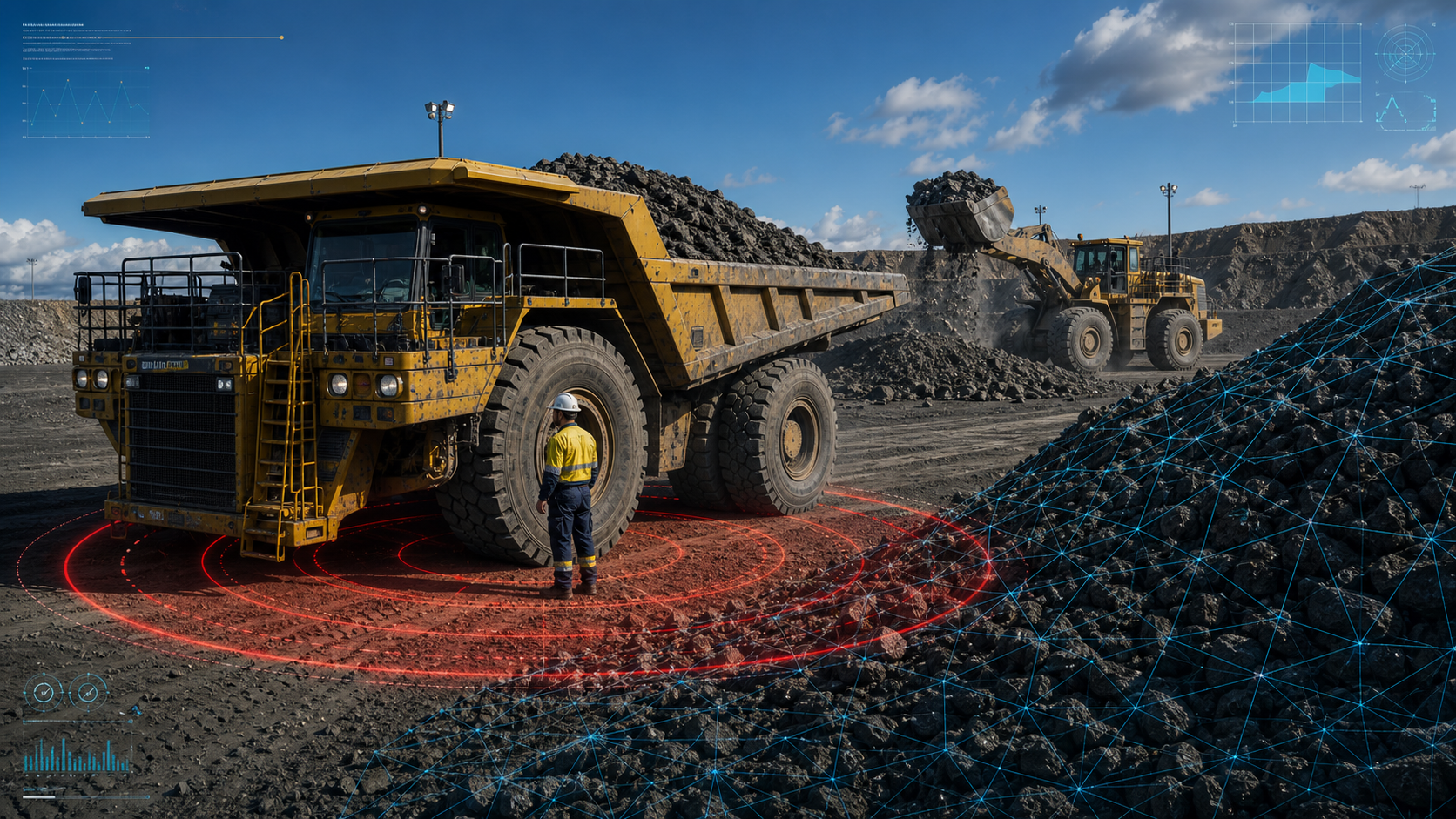
Event vision concept showing mining equipment, ROM stockpile and person danger-zone detection

Low power edge AI

Vision outputs must become decisions, not just footage.

Event vision sits inside the low power edge AI pathway. A person inside a machine danger zone, an abnormal machine interaction, a fatigue cue or a stockpile surface change should become a local signal that TRAK can route into review, escalation, work planning or evidence capture.

Non-contact monitoring

Edge telemetry extends the field record beyond manual entry.

The non-contact monitoring direction points to the right device mix: event cameras, HD image cameras, thermal imaging, temperature, gas, smoke, microphones, speakers, GNSS, cellular, Bluetooth, Wi-Fi and mesh networking between device nodes. The industrial use cases are equally clear: thermal monitoring, acoustics, vibration, particle analysis, high-speed counting, product quality and environment reconstruction.

VibrationBearing, pump, gearbox, drill and rotating-equipment signatures can flag abnormal conditions before they become breakdown events.
AcousticImpulse, knock, pipe, pump and abnormal noise signatures can be treated as low-data field signals for review.
ThermalThermal drift around motors, hydraulics, electrical zones and fixed-plant components adds another condition layer.
Event visionSparse event data supports low-latency people, machine, proximity and ROM surface-change detection where full video is too heavy, too slow or too data-intensive.
Low power edge AISparse local inference is the main pathway for low-data field decisions, treated vendor-neutrally unless a selected commercial pathway is confirmed.
TRAK linkSignals become useful when they create reviewable actions, evidence requirements, fault context or workflow triggers in TRAK.

Operations + integration

Maintenance improves when operations, systems and telemetry connect.

The local maintenance management material covers the real operating ground: incident management, isolation and lock-out, mobile and fixed plant tagging, lifting and rigging, hazardous substances, maintenance planning, defects, pre-start inspections, scheduled servicing, breakdown escalation, major component failure, procedures, plant inspections, task observations and audits.

The language stays operational: plan, execute, inspect, escalate, close out, review, report and improve. The improvement comes from connecting maintenance controls to ERP, operational technology, automated mine systems, communications, telemetry and reporting.

Operational oversightScheduled maintenance, defects, backlog, people, assets and evidence readiness become visible before work drifts.
System integrationERP, communications, telemetry, sensors and control-room data can be mapped into workflows and reporting instead of sitting in separate silos.
AccountabilityProcedures, inspections, task observations and completion packs give supervisors a way to review the work after the shift.

Accuracy principles

Public claims stay strong because they stay controlled.

AI assists reviewLow power edge AI can surface event vision and telemetry signals, but TRAK approval language should stay tied to controlled package state and human review.
No false partnershipsLow power edge AI pathways are positioned as technical evaluations unless a confirmed commercial relationship exists.
No surveillance framingLocation and field context should be presented as package-facing reliability states, not worker tracking as the core product story.
No generic proof claimsAvoid generic claims like tamper-proof records, blockchain proof or AI proving a job. The stronger language is approved package revision, revision lineage and verifier-readable manifest.
Validate pilotsROM stockpile depth and volume models should be validated against survey, payload, belt scale or agreed operational reference data.
Protect the detailsPublic material can explain the company capability without exposing recipe predicates, digest internals, connector rules or detection thresholds.

Implementation pathway

A practical route from concept to operating value.

01 BaselineMap the work-order, inspection, closeout, audit, customer and ERP flow for the target site or fleet.
02 Configure TRAKSet up assets, work order states, inspections, scan tags, users, approval gates and completion-pack expectations.
03 Add sensingSelect the low power edge AI signals, including event vision, vibration, acoustic or thermal signals, that solve a specific maintenance or safety problem.
04 Pilot locallyValidate model outputs against known references, field feedback and supervisor review before scaling.
05 IntegrateConnect approved TRAK records to ERP, reporting, customer/project boundaries and export workflows.
06 ImproveUse drill service team feedback and maintenance audit findings to refine forms, procedures, sensors and workflows.
DD421-style underground drill rig in a workshop with mechanic and field service ute

Field reality

Drill service teams keep the work grounded in the field.

The drill service team is not a side note. It is the field reality that keeps TRAK, sensors, audit language and integration priorities connected to the machines that drive production output.

Project planning

Successful planning covers construction, digitisation and operational technology.

Site projects need scope, cost, sequencing and delivery discipline across construction, digital workflow rollout, operational technology, communications, telemetry and automation interfaces.

This is successful planning in plain terms: clear scope, realistic staging, contractor coordination, cost control, safe execution, controlled handover and records that operators can use.

Source basis

Material used for this position.

This public white paper was prepared from working material, including TRAK product documentation, TRAK evidence-assurance terminology, non-contact monitoring concepts, maintenance management material and mine-site infrastructure planning documents.

  • TRAK workflow management and proposal material describing work orders, employee assignments, digital documentation, pre-task risk activity, inspections, time tracking, offline function and API integration.
  • TRAK evidence-assurance material describing approved package revisions, normalized evidence-recipe state, structured blocker objects, revision lineage, verifier-readable manifests, package evidence state and export mapping proof.
  • Non-contact monitoring material covering low power edge AI, event cameras, thermal imaging, gas, smoke, temperature, microphones, GNSS, mesh networking, thermal, acoustics and vibration.
  • Maintenance management material covering planning, servicing, breakdowns, defects, isolation, tagging, audits, procedures, plant inspections and task observations.
  • Mine-site infrastructure, construction, digitisation and operational technology planning material covering budgeted delivery, Australian standards, safety zones, serviceability, utilities, communications, telemetry, handover evidence and workshop fit-out detail.

Next step

Turn the capability map into a site pilot.

The right starting point is a focused site problem: a fleet, a maintenance workflow, a ROM-pad monitoring need, a fatigue/proximity risk, an ERP handoff or a drill service reliability target.